

Ceramic parts are hard, wear-resistant, heat-resistant, and useful in some pretty demanding applications. But the catch is, they're difficult to manufacture.
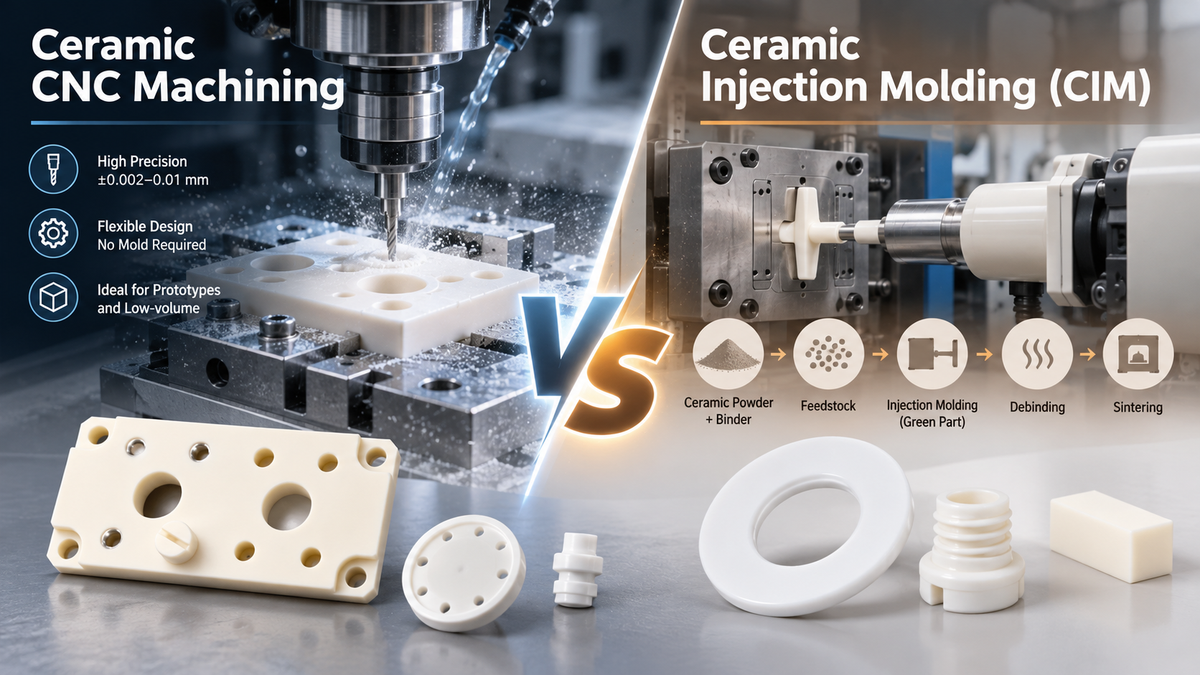
Typically, there are two main options: ceramic CNC machining and ceramic injection molding (CIM). Both can produce high-performance technical ceramic parts, but they take very different routes to get there.
The real challenge is not simply whether a part can be made by CNC or CIM. In many cases, both are technically possible. The harder question is which process makes more sense for the part geometry, tolerance, production volume, lead time, and total cost.
In this article, we will compare the two processes in great detail and help you decide which to choose for your custom ceramic parts with realible performance and consistent quality in terms of cost and efficiency.

Ceramic CNC Machining vs CIM: Brief Comparison
To make the comparison easier, let’s start with a quick overview.
| Comparison | Ceramic CNC Machining | Ceramic Injection Molding (CIM) |
| Typical Tolerance | Grinding: ±0.002–0.005 mm; general CNC: about ±0.01 mm | As-sintered: typically ±0.3%–±0.5%; about ±1% for general tolerance estimates |
| Surface Finish | Grinding: Ra 0.1–0.4 µm; lapping/polishing can reach Ra <0.1 µm | As-sintered finish is rougher; critical surfaces often need grinding or polishing |
| Sintering Shrinkage | None for fully sintered ceramic | Typically 15%–25% linear shrinkage; mold size must compensate |
| Geometry | Best for flats, holes, slots, threads, bores, and precision features; complex cavities cost more | Better for complex 3D shapes, thin walls, internal features, and near-net-shape parts |
| Material Waste | Higher | Low |
| Best Volume | Prototypes, R&D, low-volume parts, and secondary finishing | Medium- to high-volume production |
| Upfront Cost | No mold cost; machining time and diamond tooling add cost | Higher due to mold, trials, debinding, and sintering development |
| Lead Time | Faster for prototypes and first parts | Longer upfront due to tooling and process validation |
| Design Changes | Flexible; update CAD/program and remachine | Less flexible; changes may require mold modification or new tooling |
In short, CNC offers more flexibility and tighter local dimensional control, while CIM is better suited to complex geometry and higher-volume production.
What Is Ceramic CNC Machining?
Ceramic CNC machining is a computer-controlled subtractive process used to make precise parts from technical ceramics such as alumina, zirconia, aluminum nitride, and silicon nitride. CNC milling, drilling, grinding, or other precision machining methods are often used to get the required shape and dimensions.
Ceramics can be machined at different stages: green machining and hard machining.
In green machining, the ceramic is machined before full sintering. At this stage, the material is softer and easier to cut. The part is then sintered to reach its final density and properties.
Another option is to machine the ceramic after sintering. Fully sintered ceramics are much harder and more brittle, so diamond tools and precision grinding are often needed.
Think of it this way: CNC machining creates the final part by removing material from a ceramic blank. It is especially useful for prototypes, low-volume parts, and features that need tight dimensional control.
What Is Ceramic Injection Molding?
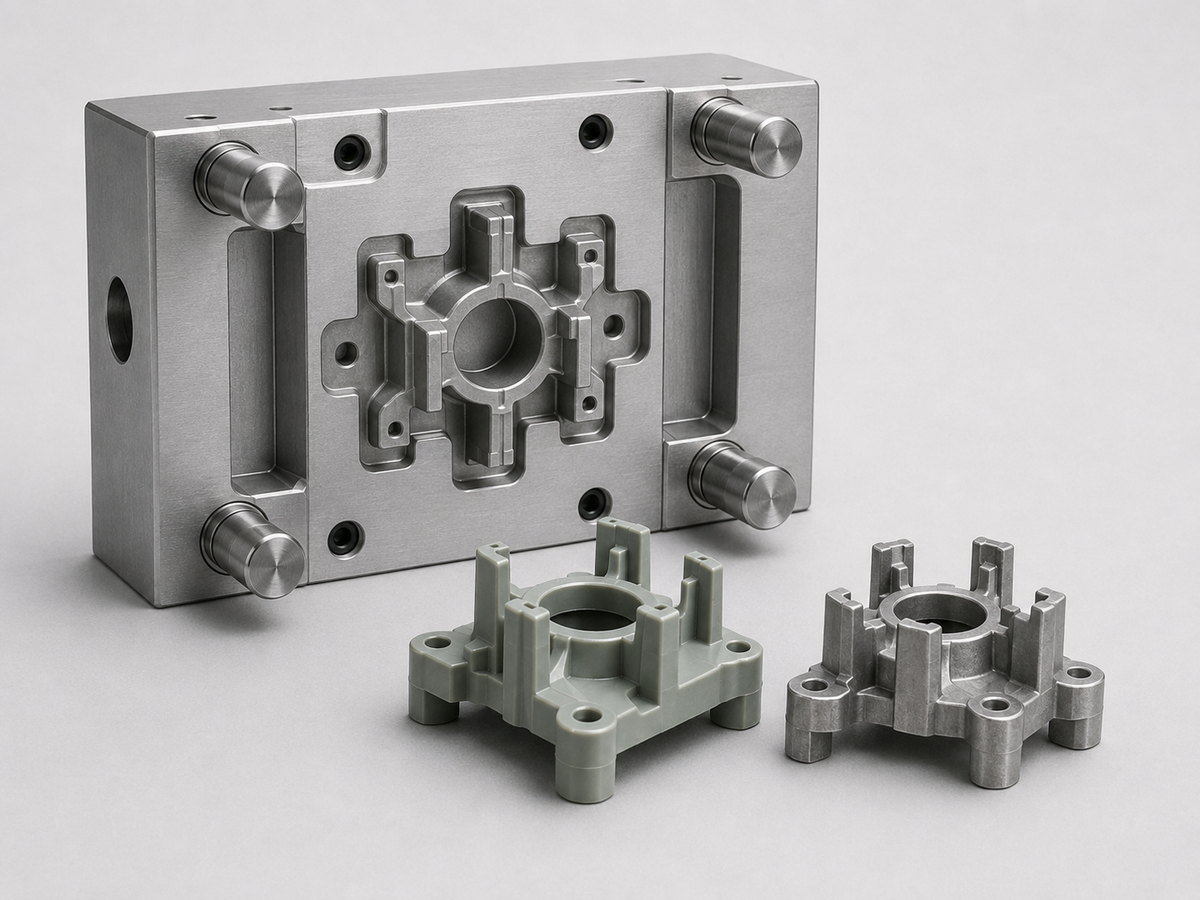
Ceramic injection molding, or CIM, is a near-net-shape process used to make complex ceramic parts, especially when the same part needs to be produced in larger quantities.
CIM is very similar to metal injection molding (MIM). Both processes mix fine powder with a binder to create a moldable feedstock. MIM uses metal powder, while CIM uses ceramic powder.
It usually involves five main steps: feedstock preparation, injection molding, debinding, sintering, and secondary finishing if needed.
First, the ceramic feedstock is injected into a mold to form the basic part shape. The binder is then removed during debinding, and the part is sintered at high temperature to become dense and strong. If tighter tolerances or a better surface finish are required, secondary grinding, polishing, or CNC machining can be added afterward.
In simple terms, CNC makes the shape by cutting material away, while CIM creates most of the shape inside the mold before sintering.
Key Differences Between Ceramic CNC Machining and CIM
Choosing between ceramic CNC machining and ceramic injection molding usually comes down to a few practical factors: production volume and cost, geometry, precision, design flexibility, lead time, material, and manufacturing risk.
Each one affects the project in a different way.
Production Volume and Cost
Ceramic CNC machining has a lower upfront cost because no production mold is needed. The trade-off is that every part still requires machine time, diamond tooling, setup, and inspection.
Ceramic injection molding starts with a higher investment. Mold design, tooling, trials, and process development all add cost before production begins. Once the process is stable, however, those costs can be spread across a larger number of parts.
So the real comparison is not just unit price. It should also include tooling, machining time, material waste, secondary finishing, inspection, and expected scrap.
There is no fixed quantity where CIM suddenly becomes cheaper. A simple ceramic part may remain economical to machine for quite a while, while a small complex part with long machining time may justify CIM much earlier.
Geometry and Design Complexity
Geometry can change the process choice just as much as volume.
Ceramic CNC machining works well when the cutting tool can reach the required features directly. Flats, holes, slots, bores, threads, sealing faces, and precision mating features are typical examples.
The catch is that complexity adds machining time. More sides may mean more setups. Deep or narrow features may require smaller tools, and internal shapes can become difficult or even impossible to reach.
Ceramic injection molding creates most of the geometry inside the mold. That gives it more freedom for complex 3D shapes, curved surfaces, ribs, bosses, small repeated features, and some internal structures.
Still, not every complex shape is easy to mold. Thin walls, deep holes, undercuts, internal cavities, sharp corners, and threads all need a proper DFM review. Some features may be possible on paper but difficult to mold, debind, or sinter reliably.
Precision and Surface Requirements
Ceramic CNC machining gives more direct control over critical dimensions.
Precision grinding can commonly reach around ±0.002–0.005 mm, while general ceramic CNC machining is often around ±0.01 mm, depending on the material, part size, and feature.
Ceramic injection molding relies on molding and sintering, so final dimensions are affected by shrinkage. As-sintered tolerances are commonly around ±0.3%–±0.5%, while around ±1% may be used as a broader general estimate.
Surface finish follows the same pattern. Precision grinding commonly reaches around Ra 0.1–0.4 µm, while lapping or polishing can go below Ra 0.1 µm when needed.
CIM can also produce a good as-sintered surface, but mold finish, gate location, parting lines, and sintering all affect the result.
In practice, features such as precision bores, sealing faces, datum surfaces, flatness, or parallelism may still need secondary grinding or CNC finishing.
Design Flexibility
CNC machining is much easier to adjust when the design is still changing.
If a hole moves, a diameter changes, or a wall becomes thicker, the CAD model and machining program can usually be updated without changing production tooling.
Ceramic injection molding is less flexible once the mold has been made. A change in wall thickness, hole position, ribs, or internal geometry may require mold modification. Sometimes a new insert is enough; sometimes the change is more involved.
That is why design maturity matters.
If the part is still going through several revisions, CNC machining gives much more room to adjust.
Lead Time
For prototypes and first parts, ceramic CNC machining usually has the shorter route.
Once the drawing and material are confirmed, the work mainly involves programming, setup, machining, grinding, and inspection.
Ceramic injection molding needs more preparation before the first qualified parts are ready. Mold design, tool manufacturing, trial molding, process adjustment, debinding, sintering, and dimensional validation all take time.
So the first-part lead time is usually longer.
Once the mold and process are qualified, however, CIM becomes much more efficient for repeat production.
Think of lead time in two parts: time to first part and time to produce the full batch. The answer may be very different.
Materials and Applications
Ceramic material choice can shift the balance too.
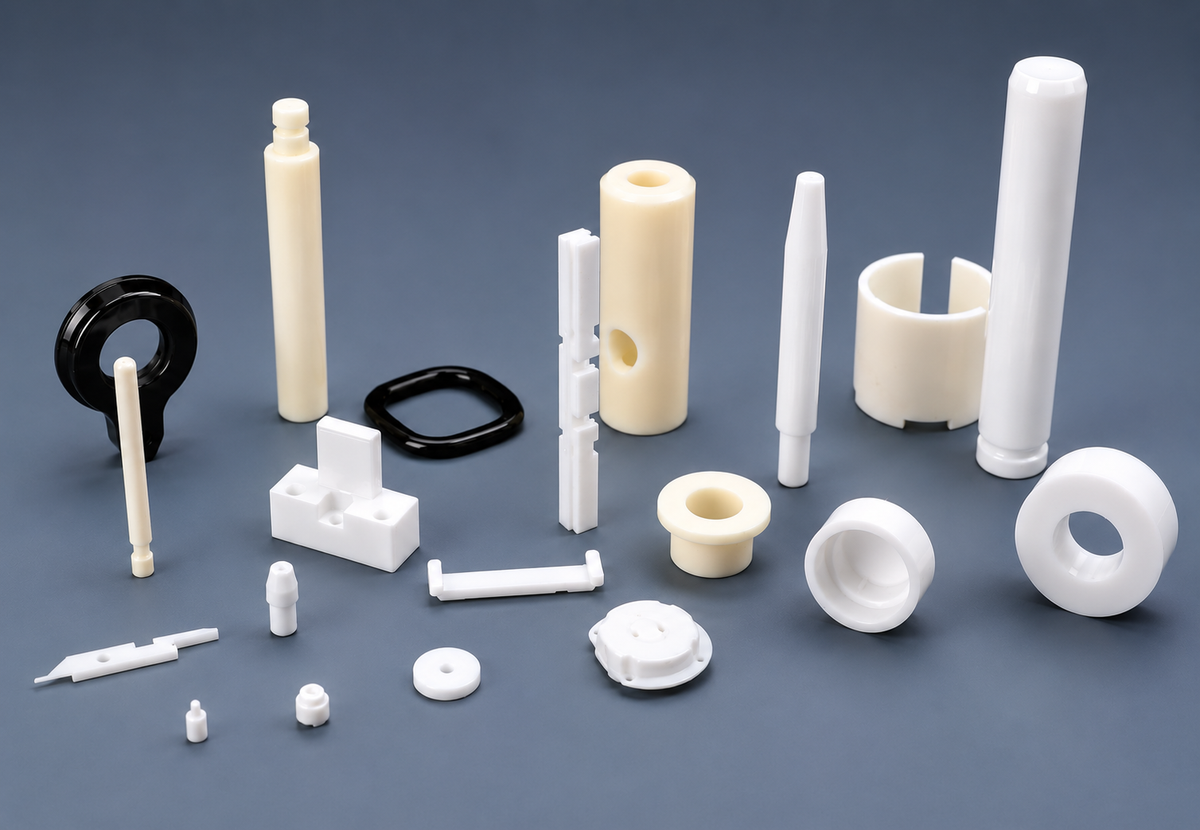
Alumina and zirconia are common in both CNC machining and ceramic injection molding. Alumina is widely used for insulation, wear parts, and semiconductor components, while zirconia is often chosen where toughness, wear resistance, and a smooth surface matter.
Silicon nitride, aluminum nitride, and silicon carbide are more demanding, especially after full sintering. Heavy material removal can be slow, and tool wear may rise quickly.
More specialized ceramics can behave very differently. Boron nitride, for example, is relatively machinable compared with many structural ceramics and is often CNC machined for high-temperature, vacuum, and electrical insulation applications. Other materials, such as yttria-stabilized zirconia or high-purity alumina, may be better suited to molding when the part is small, complex, and produced repeatedly.
These material differences also show up in real applications.
Ceramic CNC machining is often used for semiconductor fixtures, precision plates, custom ceramic parts, prototypes, and components with ground reference surfaces.
Ceramic injection molding is more common for small, complex parts used in electronics, medical devices, automotive systems, sensors, insulation, and other repeat-production applications.
Quality, Consistency, and Manufacturing Risk
The two processes have very different risk points.
With ceramic CNC machining, most problems come from the hardness and brittleness of the material. Edge chipping, cracks, microcracks, tool wear, and dimensional drift can all appear during machining. Thin walls, sharp edges, and heavy material removal increase the risk.
Ceramic injection molding has a different set of concerns. Incomplete filling, weld lines, density variation, debinding cracks, shrinkage variation, warpage, and sintering distortion are more typical. These issues are closely tied to feedstock, mold design, molding conditions, debinding, and furnace control.
Consistency also depends on where the variation comes from.
CNC machining gives strong control over critical features, but tool wear, setup, and inspection still need to be managed from part to part.
CIM can deliver very stable repeatability once the mold and process are qualified, but only if raw powder, feedstock, molding parameters, debinding, sintering, and secondary finishing stay under control.
For medical, semiconductor, automotive, aerospace, and other controlled industries, traceability is part of the same picture. Material batches, furnace records, inspection results, and production lots may all need to be tracked.
How to Choose Between Ceramic CNC Machining and CIM
The right process depends on what matters most for the part: volume, geometry, tolerance, design maturity, lead time, and cost.
Choose Ceramic CNC Machining When
Ceramic CNC machining is usually the better choice when:
-
the project is still in the prototype or R&D stage
-
production volume is low
-
the design may still change
-
the geometry is relatively simple
-
several critical dimensions need tight control
-
fast first-part delivery matters
-
mold investment is hard to justify
CNC gives you more flexibility, especially when the design is not fully fixed yet.
Choose Ceramic Injection Molding When
Ceramic injection molding makes more sense when:
-
the part is small and complex
-
the design is already stable
-
production volume is medium or high
-
the part has many integrated features
-
CNC machining would require several setups
-
material removal would be high
-
repeatability matters across larger batches
-
tooling cost can be spread across enough parts
CIM works best when complex geometry and repeat production come together.
Choose CIM + CNC Machining When
A hybrid process is often the better route when the part needs both complex geometry and high precision.
CIM can create the near-net shape, while CNC machining, grinding, lapping, or polishing is used only on the features that need tighter control.
Typical examples include:
-
precision bores
-
sealing surfaces
-
datum faces
-
bearing seats
-
flatness-critical areas
-
tight-tolerance threads
-
precision locating features
This approach reduces unnecessary machining while keeping precision where it matters most.
Final Thoughts
Ceramic CNC machining gives you flexibility.
CIM gives you scalability.
That is probably the simplest way to look at it.
For prototypes, changing designs, simple geometry, and low production quantities, CNC machining is often the practical choice.
For small, complex ceramic parts that need to be produced again and again, CIM can reduce machining and make volume production more efficient.
And sometimes, the best process is not one or the other.
CIM creates the complex shape. CNC machining finishes the dimensions that really matter.
If you are evaluating a ceramic part, start with four things: the drawing, material, expected annual volume, and critical tolerances. From there, it becomes much easier to decide whether CNC machining, CIM, or a combined process makes the most sense.
Frequently Asked Questions
1. Can I use CNC machining for prototypes and then switch to CIM for mass production?
Yes. CNC machining is often a good choice for early prototypes because design changes are easier. Once the design is stable and volume increases, the part can be reviewed and optimized for CIM.
2. Does a CIM part always need secondary machining?
No. Many CIM parts can be used close to their as-sintered condition. Secondary grinding or CNC machining is mainly used for critical features such as precision bores, sealing faces, or flatness-controlled surfaces.
3. Can an existing CNC ceramic part drawing be used directly for CIM?
Not always. CNC-friendly features may not be ideal for molding and sintering. A DFM review is usually needed to check wall thickness, radii, draft, holes, and tolerance requirements.
4. How stable should the design be before making a CIM mold?
The main geometry and functional dimensions should already be confirmed. Small changes may still be possible, but larger changes can require mold modification or new tooling.
5. How should critical dimensions be handled in CIM parts?
Focus tight tolerances only on features that really need them. Critical bores, locating surfaces, sealing areas, or datums can be finished by secondary grinding or machining if needed.
6. Is CIM suitable for very small ceramic parts?
Yes. CIM is well suited to small, complex ceramic parts. However, wall thickness, tiny holes, mold filling, handling, and sintering still need to be reviewed together.
Share:
Metal Injection Molding Steel: Materials, Properties, and Design Guide
Metal Injection Molding Cost Per Part: What Affects the Price?